Spectrophotometer | High-Precision Industrial Color Testing Equipment
Overview
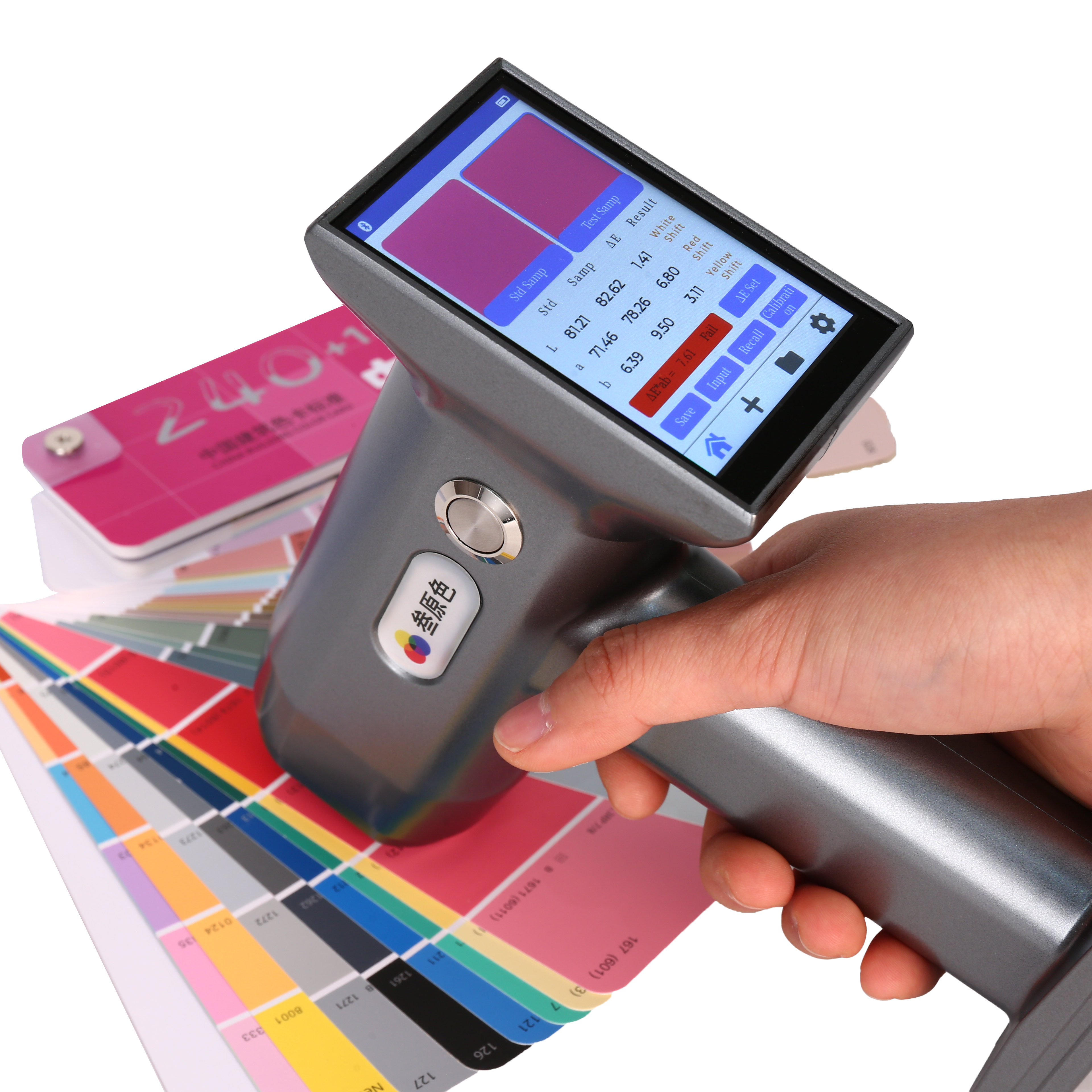
YS10 series spectrophotometer is jointly developed by Guangzhou Tricolor Quantum Technology and Xiamen Wansepu Institute of Color Science. It is professional industrial high-precision color testing instrument for factory standardized color management and supply chain color consistency control.
Adopting imported Hamamatsu optical sensor, this color testing device supports 380nm-780nm wide spectrum detection with 1nm ultra-fine sampling precision. It is widely applicable for color measurement of packaging paper, paint coating, textile fabric, leather, metal parts, plastic and 3C electronic accessories.
Our spectrophotometer has passed multiple international metrology certifications. It is perfectly used for production quality inspection, batch color consistency verification and unified color standard management in many large manufacturing factories. It realizes high stable color detection with high cost performance.
Core Technical Advantages
- Stable testing accuracy, color difference error controlled within ΔE 0.000~0.005, fully meeting high-standard factory color inspection demand
- Built-in D65, D50, A, F series multi-standard light sources, simulating different ambient light detection environment
- Equipped with 4mm, 8mm, 12mm switchable detection apertures, suitable for big and small sample testing
- Excellent repeatability ≤0.005,realizing unified color data among multiple production workshops
- Fast detection speed, only 1 second for single test, supporting mass continuous sample inspection on production line
- Wide working temperature range from -10℃ to 45℃, IP54 dustproof and waterproof, adapt to complex factory workshop environment
- Large storage capacity for 20000 groups color data, support USB, Bluetooth, WIFI data export to Excel and PDF
- Compatible with SAP, UFIDA ERP system and professional color management platform to complete factory data traceability
Main Industry Application
Leather & Luxury Goods Industry
Accurately detect surface color difference of leather materials and finished products, complete multi-light source color comparison, effectively control finished product color uniformity and improve brand product quality.
3C Electronics Industry
Stable color detection for electronic shell, accessories and outer packaging, ensure unified batch color of electronic products, reduce defective rate caused by color deviation.
Textile Printing & Dyeing Industry
Control fabric, auxiliary material and printing pattern color difference, solve color inconsistency problems in dyeing production, help textile factories stabilize production color standard.
Coating & Ink Industry
professional color matching and color difference evaluation for all kinds of paint, ink and coating materials, provide accurate spectral data basis for formula debugging and batch production.
Packaging & Printing Industry
Evaluate printing color deviation, quickly locate color abnormal position, help printing factories improve product color restoration degree and meet customer color standard requirements.
R&D Strength & Factory Value
We are a professional color testing instrument manufacturer with independent optical research and development, hardware production and algorithm debugging capabilities. All core circuit structure, optical path design and spectral analysis algorithms are independently developed by our technical team.
Compared with imported same-precision spectrophotometer, our equipment saves 50%~70% procurement cost, with low later maintenance cost and no extra consumables. We provide remote guidance and on-site technical after-sales service for large factories.
This industrial spectrophotometer focuses on helping manufacturing enterprises establish complete color quality control system, realize standardized production process, effectively optimize product color consistency, and enhance core market competitiveness for factories.