
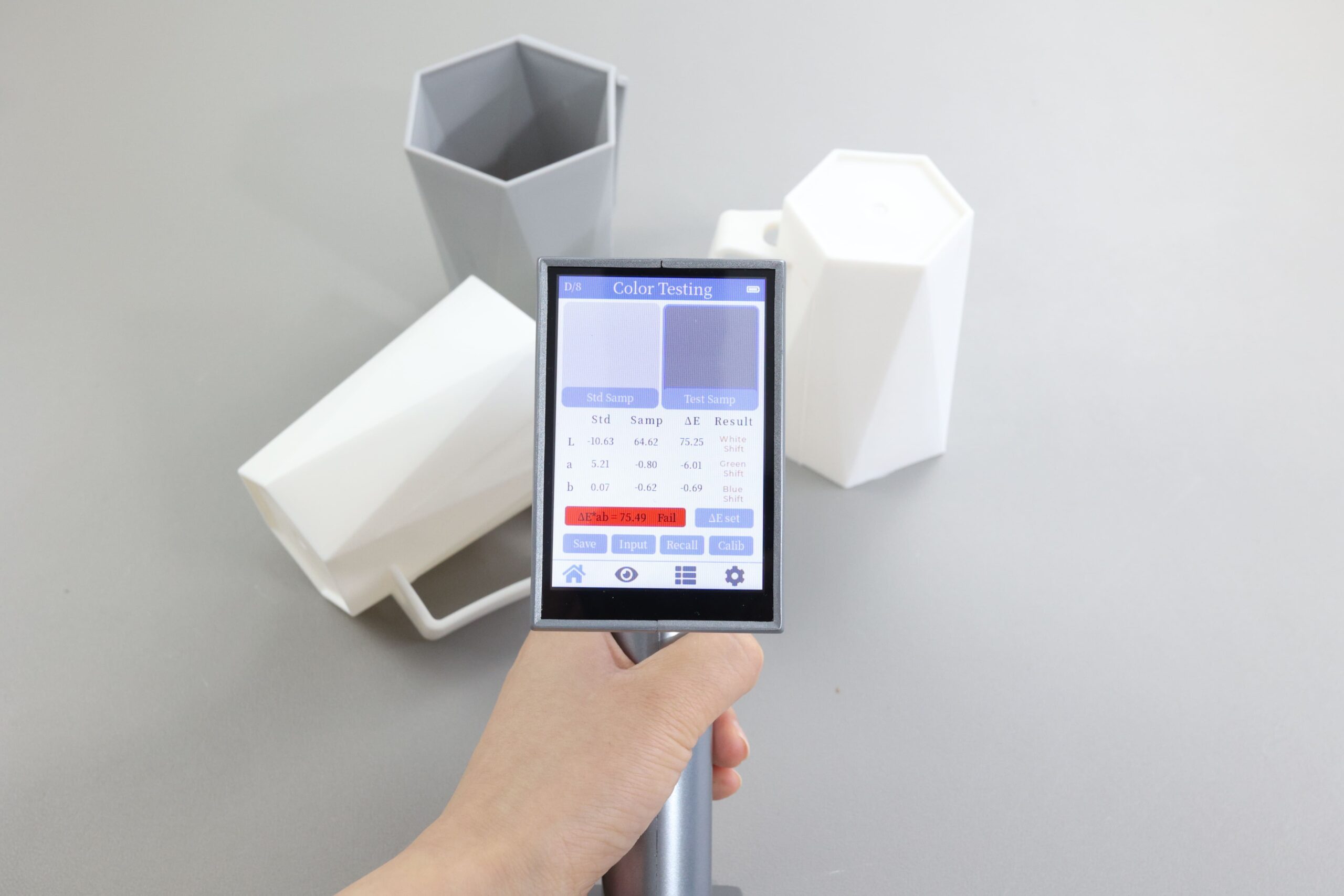
Batch color inconsistency remains the biggest pain point for plastic injection and modification factories. Raw material batch differences and injection temperature fluctuations often cause obvious color deviation. Human visual judgment is limited. It can only distinguish color differences with ΔE>1.12. However, tiny deviations below this threshold frequently lead to customer complaints and high defective rates. ASTM D2244 serves as the official standard for solid plastic color difference testing. It specifies clear requirements for measurement aperture, light source, and data output format. The Sanyuanse spectrophotometer is specially optimized for plastic batch color control. It adopts a D/8° integrating sphere optical structure. This design effectively eliminates surface gloss interference from plastic products. The instrument supports 4 mm and 8 mm switchable measurement apertures. Users can apply the 4 mm aperture for small electronic plastic parts. The 8 mm aperture is suitable for large-area plastic panels. Factories must confirm standard color values with raw material suppliers before mass production. L, a, b data from the spectrophotometer will then serve as the unified production reference. Inspectors need to conduct random spot checks every 30-60 minutes during continuous production. They must collect color data from plastic particles, semi-finished products, and finished parts respectively. The system operates based on the CIE DE2000 formula. It automatically calculates the ΔE value between the test sample and the standard value. Factories can set internal tolerances according to specific product grades. Ordinary daily plastic products usually adopt a ΔE≤1.0 tolerance. High-grade electronic plastic accessories typically require ΔE≤0.6. The spectrophotometer is capable of storing hundreds of groups of batch color data. Users can export all data to Excel for quality traceability and production record archiving. Translucent and milky white plastic materials require 400-700 nm full-spectrum testing. Narrow-band spectrocolorimetes often fail to accurately judge the whiteness deviation of semi-transparent plastics. Sanyuanse equipment adopts a 400-700 nm full visible spectrum design. It accurately captures subtle whiteness and hue changes in modified plastic materials. All plastic testing instruments pass strict pre-delivery calibration using national standard color tiles. The ΔE repeatability reaches ≤0.01. This precision is far higher than human visual resolution. We provide targeted plastic color control schemes for injection molding and plastic modification factories. Sanyuanse spectrophotometers are a cost-effective solution for manufacturers pursuing stable batch color.