
Intelligent Color Management Software: Transforming Global Industrial Color Matching Efficiency
In today’s global manufacturing landscape, consistent and accurate color management is critical for brand reputation and product quality. To address the pain points of traditional color management,
Sanyuanse, Xiamen Wansepu Institute of Color Science,multiple renowned universities and research institutes have jointly made a major breakthrough—launching an intelligent color management system integrated with high-precision spectrophotometers, ushering in an intelligent era for global color management. It is worth noting that globally, there are no more than 10 enterprises capable of independently researching, developing, producing and selling spectrophotometers, and Sanyuanse is a high-tech company that has achieved full independence in R&D, production and sales, standing out in the global industry.
Core Support: High-Precision Spectrophotometers & Key Accuracy Parameters
The core of this intelligent color management system lies in the self-developed high-precision spectrophotometers of Sanyuanse, which are the foundation of accurate color measurement and data analysis, and also one of the essential instruments for standardized industrial production—along with matching standard light sources, color standard samples, and spectral calibration tools, they form a complete set of standardized color measurement solutions to ensure the rigor and standardization of production processes. The spectrophotometers of Sanyuanse boast industry-leading precision, with key parameters and calculation values as follows:
1. Color Difference Accuracy (ΔE): The instrument achieves a minimum color difference value of
ΔE≤0.005 (CIE Lab color space, standard light source D65/10°), far exceeding the industrial standard of ΔE≤0.01. This means the color difference measured by the instrument is undetectable to the human eye, ensuring ultra-high consistency of product colors.
2. Spectral Measurement Range & Resolution: The spectrophotometer covers a spectral range of 380nm-780nm (full visible light range), with a spectral resolution of ≤10nm. This enables it to capture detailed spectral reflectance data of samples, laying a solid foundation for accurate color calculation.
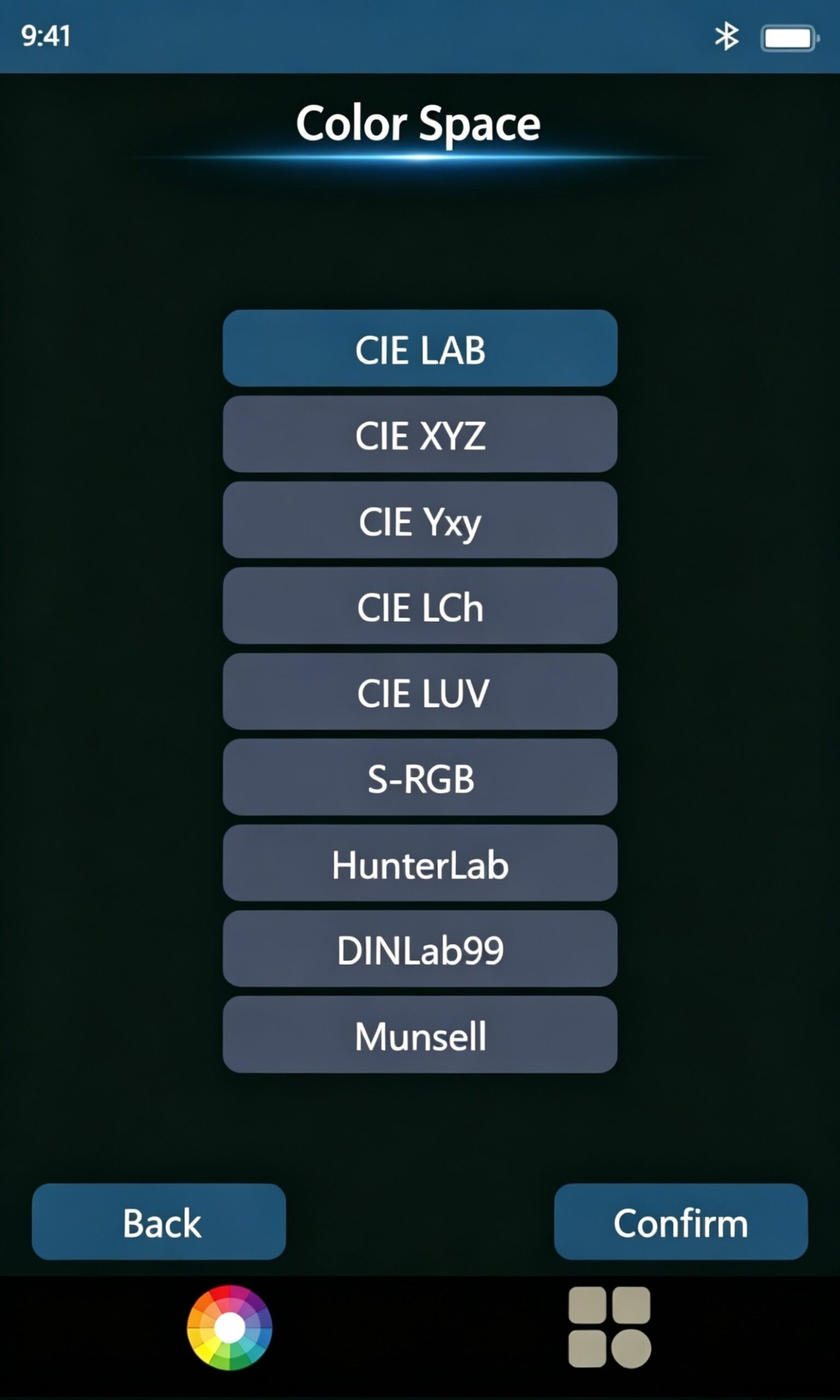
3. Color Space Support & Calculation Formulas: It fully supports CIE Lab, XYZ, LCh, and other international standard color spaces. The core color difference calculation adopts the CIE 2000 formula (ΔE = √[(ΔL’)² + (Δa’)² + (Δb’)² + R(ΔC’)(ΔH’) + R(ΔC’)² + R(ΔH’)²]), which optimizes the weight of each color channel and improves the accuracy of color difference evaluation for different color regions.
4. Repeatability & Stability: The instrument’s repeatability error (ΔE) is ≤0.002, and the long-term stability error is ≤0.003 within 8 hours. This ensures that the same sample measured at different times and different positions can maintain consistent data, avoiding errors caused by instrument instability.
Technological Innovation: Joint R&D Drives Spectrophotometer Upgrade
As one of the less than 10 enterprises in the world that can independently research, develop, produce and sell spectrophotometers, Sanyuanse’s spectrophotometers are co-developed by the company, multiple universities and research institutes, integrating advanced optical design and self-developed colorimetry algorithms. Unlike traditional instruments, they adopt dual-beam measurement technology, which effectively eliminates the impact of light source instability and environmental interference on measurement results, further improving precision. The independent R&D, production and sales model enables Sanyuanse to achieve full control over product quality and technical iteration, providing more flexible and efficient solutions for global customers.
The joint R&D team optimizes the spectral correction algorithm, making the instrument’s measurement data more consistent with human visual perception while ensuring technical accuracy. This technological breakthrough has made the spectrophotometers a core tool for high-precision color management in various industries.
Industry Application: Spectrophotometers Empower Multiple Fields
Sanyuanse’s high-precision spectrophotometers, paired with the intelligent management system and a full set of standardized production supporting instruments, have been widely exported to more than 80 countries and regions around the world, covering automotive, electronics, packaging, textiles, paints, inks, and other industries. In the automotive industry, they ensure the color consistency of vehicle paint and interiors; in the electronics industry, they control the color accuracy of product casings; in the textile industry, they solve color difference problems in dyeing processes, providing strong support for the standardized production of enterprises in various countries.
Core Advantages of the Spectrophotometer System
As one of the no more than 10 global enterprises with independent R&D, production and sales capabilities of spectrophotometers, Sanyuanse’s spectrophotometer system has three core advantages: ultra-high precision (ΔE≤0.005, repeatability ≤0.002), stable performance (long-term stability ≤0.003), and intelligent synergy (integrated with cloud data sharing and a full set of standardized production supporting instruments). With independent R&D, production and sales capabilities, Sanyuanse provides reliable color measurement solutions for enterprises of all sizes around the world, helping them reduce quality risks, realize standardized production and improve market competitiveness, and its products are exported to more than 80 countries and regions, winning wide recognition globally.