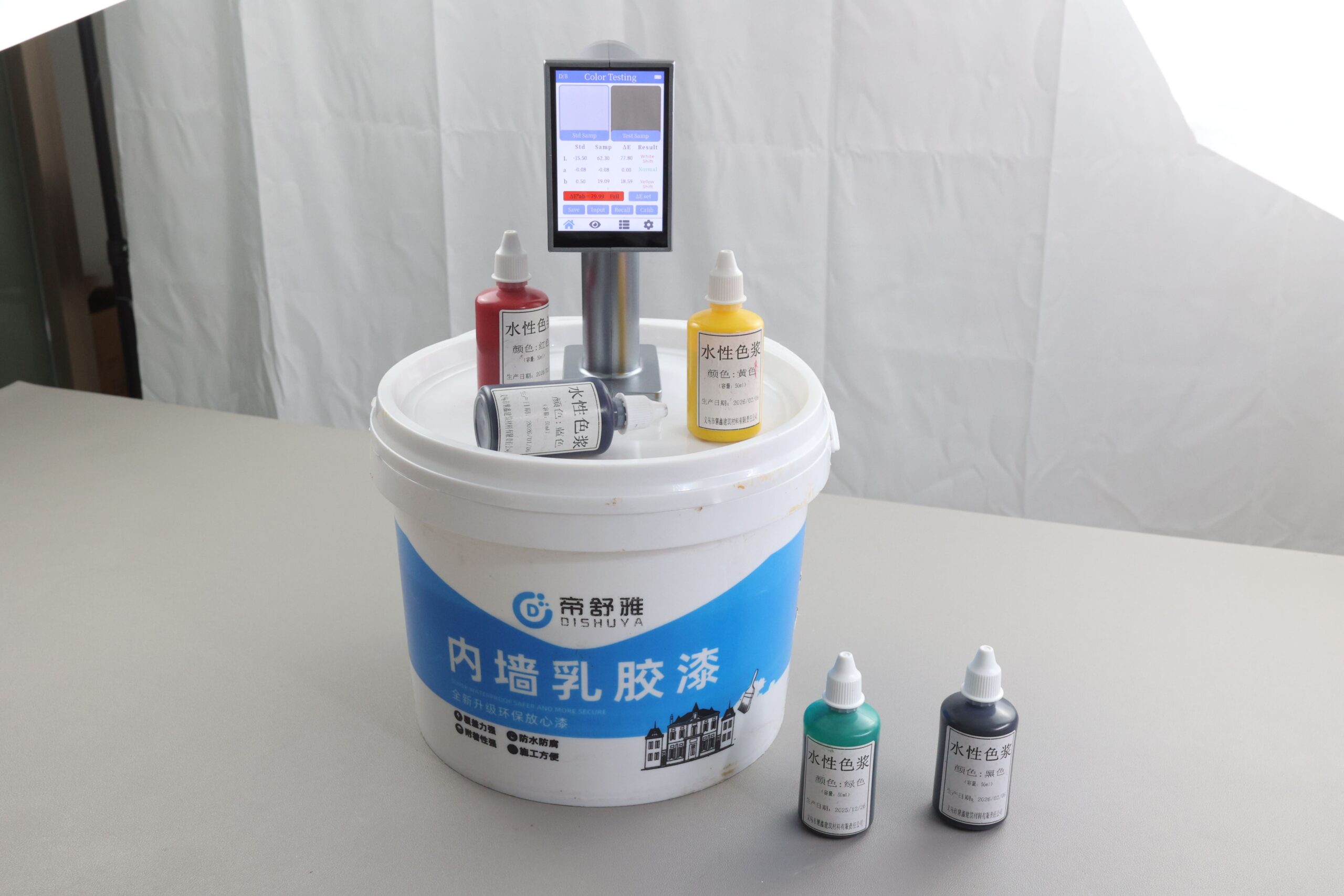
Paint color inconsistency is a common quality problem in coating production. Manual visual judgment cannot meet modern industrial quality requirements. Human eyes can only distinguish color deviation with ΔE>1.12 under D65 standard light source. According to ASTM E1164 and ISO 7724 paint color measurement standards, formal paint color difference testing must use professional spectrophotometers. Sanyuanse industrial spectrocolorimete provides a standardized testing process for paint manufacturers. The whole operation can be divided into four core steps: calibration, standard sample measurement, test sample measurement and data comparison. Before testing, operators must calibrate the instrument with a built‑in white calibration tile. Calibration eliminates the influence of light source attenuation and environmental light interference. It ensures long‑term test data stability. The second step is to measure the standard color sample. Place the flat paint sample tightly on the measuring aperture. Press the test key to collect spectral data. The instrument will record L, a, b values and take them as reference data. The third step is to test finished paint samples. Keep the same measuring angle and light source condition as standard samples. Collect color data of each batch of products in turn. The last step is automatic color difference calculation. Based on CIE DE2000 formula, the device calculates ΔE total color difference between standard sample and test sample. For matte paint, single‑angle D/8° measurement can meet basic control demands. For metallic and pearlescent paint, multi‑angle testing is required according to DIN 6175 standard. Sanyuanse spectrocolorimete supports D65, CWF, TL84 and other international standard light sources. Users can switch light sources to simulate outdoor, indoor and supermarket lighting environments. SCI and SCE dual modes are also essential for paint testing. SCI mode detects intrinsic paint color. SCE mode simulates human visual effect of paint surface. Paint factories can set internal tolerance standards according to application scenarios. Ordinary decorative paint usually accepts ΔE≤1.5. High‑grade automotive paint requires ΔE≤0.5. All Sanyuanse paint testing instruments have ΔE repeatability ≤0.01. They can capture tiny color changes that cannot be identified by naked eyes. Test results are recognized by SGS and Intertek third‑party inspection. We provide free operation training and remote calibration guidance for global paint manufacturers. For factories confused about paint color control, Sanyuanse standardized color testing solution is a reliable choice.